Water
Water Features
Basalt bubblers, rock bubblers, ponds and boulder waterfalls, set with the excavation, liner and reservoir work underneath that decides whether the feature still runs clean five years from now.
Chapter 01
A bubbler or a pond: two different problems to solve
A basalt bubbler or a rock bubbler is a disappearing feature: water rises through a drilled column or over a boulder face and vanishes back down into a buried reservoir, with no open surface of standing water anywhere in view. That makes it the low-maintenance choice for a family with young kids or pets, since there's no exposed pond edge to fall into and no open water sitting still long enough to grow algae or draw mosquitoes. A full pond, by contrast, holds a visible body of water and usually fish or plants, and it asks for real ongoing care: water testing, seasonal cleanouts, and managing the biological balance that keeps the water clear rather than green.
Neither one is the wrong answer, they solve different problems. A bubbler suits a property that wants the sound and motion of water without adding a maintenance chore or a safety consideration. A pond suits an owner who specifically wants a living water garden, fish, or the look of open water, and who's willing to put in the seasonal attention that keeps it healthy.
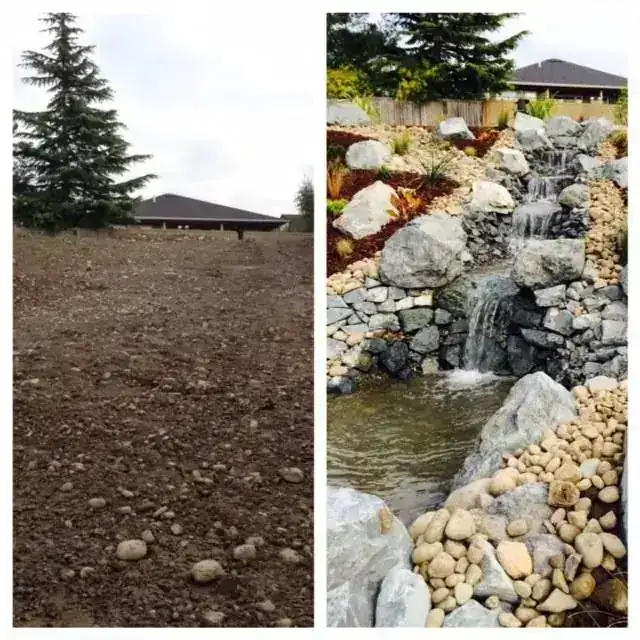
Bare graded lot becoming a finished boulder waterfall
Basalt columns read differently than stacked boulder rockery
Basalt bubblers use quarried natural stone columns, typically upright and drilled through the center for the water line, and they read as a clean, architectural feature next to a modern entry or a formal bed rather than as a naturalistic rock formation. Rock bubblers and boulder waterfalls take the opposite approach, building up irregular natural stone to look like an outcropping the water simply found, which suits a more organic, woodland-style landscape. Choosing between them is really a question of what the rest of the property is doing stylistically, not which one is objectively better.
Both share the same buried mechanics: a reservoir basin, a pump, and a way to get water from the bottom of the system back up to wherever it emerges at the top, whether that's the drilled center of a basalt column or the high point of a stacked boulder face.
Chapter 03
What's actually buried: reservoir, liner, and getting power there safely
Every disappearing feature starts with excavation for a below-grade vault that holds the pump and the reservoir of water the whole system recirculates from. That vault gets a liner and underlayment sized to hold water without seeping into the surrounding soil, because a slow leak in the liner shows up later as a reservoir that's mysteriously low every week, not as an obvious failure on install day. The reservoir has to be sized against the pump's flow rate and the surface area of stone the water runs over, since too small a reservoir empties itself onto the surrounding gravel before the pump can recirculate it properly.
Getting power to a submersible pump sitting in a below-grade vault next to standing water is its own discipline: the circuit needs ground-fault protection, and the wiring path from the vault to the power source gets planned and buried at install, not run as an afterthought once the stone is already set. This is exactly the kind of detail that's invisible in the finished photo and is the reason a water feature is a build, not a decoration dropped on top of an existing bed.
Setting the stone so it sounds and looks like it was always there
The difference between a water feature that reads as natural and one that reads as stacked rock is almost entirely in how the boulders are set. Real outcroppings have irregular faces, varied stone sizes, and water that finds its own path down them rather than running down a single uniform channel, so setting stone for a waterfall means placing pieces to break the water's fall unevenly, the way weather actually erodes a hillside over time. The drop height and the face of the stone the water hits also decide the sound the whole feature makes, a wider, lower fall over a rough face reads as a softer trickle, while a taller, narrower drop onto a harder surface reads louder and sharper, and that's tuned during the build, not fixed afterward without redoing the stonework.
Archterra pairs water feature builds with its rockery and lighting work, since a boulder waterfall and the rock retaining or accent work around it are usually built as one continuous stone feature rather than two separate jobs, and night lighting on a water feature changes how the whole thing reads after dark as much as the water itself does.
Archterra Landscape Services — locally owned and family-operated since 2005, no subcontractors. Call (253) 815-8365.
Winter shutdown and the maintenance a feature actually needs
Puget Sound winters rarely bring a hard freeze deep enough to threaten a properly built reservoir, but a feature that's shutting down for the season still gets the pump pulled and the plumbing checked so trapped water isn't sitting in a line through a cold snap. A pondless bubbler comes back up in spring with little more than a reservoir top-off and a check that the pump primes clean. A pond carries real seasonal work on top of that: managing algae and biological balance through the warm months, and a proper cleanout before the water clouds up rather than after.
That gap in ongoing care is usually the deciding factor for a family choosing between the two: a bubbler asks for almost nothing after it's built, a pond asks for real, recurring attention in exchange for open water and the life it supports.