Design & Build
Landscape Design & Installation
A free on-site design consultation, then grading, drainage and soil prep before a single plant goes in the ground. This is the service everything else on the property gets built around.
Chapter 01
The consultation comes before the drawing
The first step on every design/build project is a free, on-site consultation with a designer, walking the property to talk through the owner's vision, budget and the practical constraints of the actual site, not a template. Permits get established at this same conversation, if the scope of work needs one, and Archterra handles submitting the applications rather than leaving that paperwork to the homeowner.
Timelines get set here too, and they're honest rather than uniform: how long a project takes depends on the design decisions made at this stage, the materials chosen, whatever permits are required, the condition of the site itself, and the weather during the build window. Two properties the same size can have very different timelines once those variables are actually known.
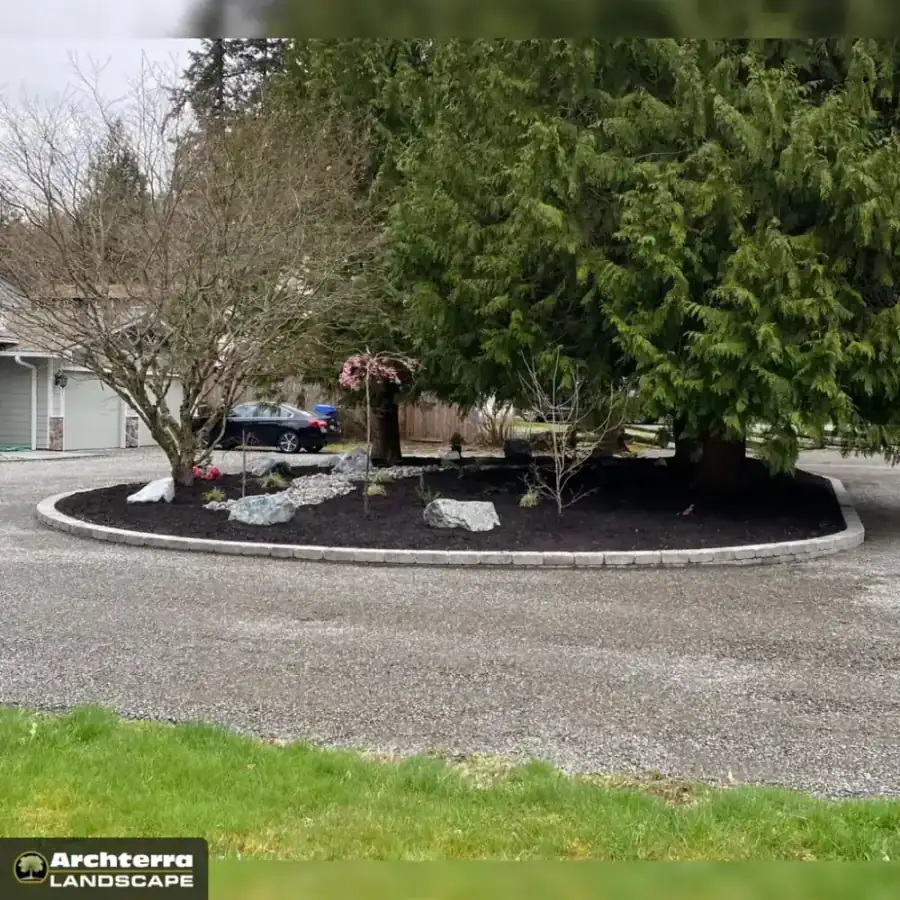
Circular planted island bed in a gravel driveway turnaround
Why the grade and the drainage get decided first
Nothing decorative goes in until the ground itself is right. Grading sets the finished contour of the property and the fall direction water takes off it, and it has to happen before beds are cut, sod is laid or a single shrub goes in, because regrading around an established planting means tearing out work that was just finished. A Pacific Northwest yard that looks flat can still be moving water toward a foundation, a fence line or a neighbor's low spot, and the design consultation is where that gets caught and corrected on paper instead of discovered after a wet winter.
Puyallup sits on heavy clay in a lot of neighborhoods, and clay behaves differently than a sandy loam: it drains slowly, holds water against root balls longer than most plants tolerate, and can shift enough through a wet season to move a poorly set edge or bed line. Soil prep on a clay lot usually means working in compost and coarser material to open the structure up before planting, not just tilling the surface and hoping. Skipping that step is the single most common reason a newly planted bed looks fine in September and struggles by the following spring.
Chapter 03
Sod, hydroseed, or synthetic turf, and when each one is the right call
Sod gives an instant, usable lawn, and it's the right choice when there's foot traffic scheduled soon after installation, a slope that needs to hold immediately, or a homeowner who wants the yard to look finished the day the crew leaves. It costs more per square foot than hydroseeding and needs consistent watering through establishment, but it's ready for light traffic within a few weeks rather than a season. Hydroseeding, by contrast, is a slurry of seed, mulch and fertilizer sprayed over prepared soil, and it costs less over a large area, but it takes longer to establish and needs the same careful watering hydroseed always needs, with the lawn unusable until it fills in.
Synthetic turf earns its place where a living lawn genuinely can't win: heavy shade under mature trees where grass thins out no matter what's tried, a slope steep enough that mowing is a hazard rather than a chore, a yard with dogs that turns real grass into mud and bare patches, or a dedicated putting green that needs a consistent, mowed-every-day surface without the maintenance. It isn't the default answer for a normal front lawn, it's the answer for the specific spot where sod and hydroseed both lose.
Planting for what the bed looks like in five years, not on install day
Archterra's designers and horticulture specialists choose plants against the actual conditions of the spot they're going into, not a catalog photo: soil type, sunlight availability, moisture, and the plant's own size, shape, texture and growth habit at maturity. A shrub planted at the spacing its nursery pot suggests looks sparse for the first year or two and then crowds its neighbors for the next twenty, once it reaches the size the species actually grows to.
Winter is deliberately the slow season for design and planning work, because it's the point in the calendar before the spring and summer lead times start stretching out. A design finalized over the winter is ready to move into construction as soon as the weather and the season allow, instead of getting queued behind everyone who waited until the yard already looked bad to call.
Archterra Landscape Services — locally owned and family-operated since 2005, no subcontractors. Call (253) 815-8365.
Seasonal grading isn't a one-time job on a working property
A property's grade can shift after the first year through settling, seasonal freeze and thaw cycles, and heavy rain events, especially anywhere fill was brought in or a bed was recently cut. Seasonal grading checks the fall of the land against what the original design called for and corrects any low spot that's started holding water before it turns into a drainage problem for a lawn, a bed, or a structure nearby.
Every install on this page, whether it's a full property redesign or a single new bed, follows the same sequence: consultation and permits first, grade and drainage second, soil prep third, and only then the sod, hydroseed, turf or plants that actually show.