Water supply
Irrigation Installation & Repair
Design, installation, troubleshooting and repair for homes and commercial properties, with annual start-up, winterization and backflow prevention built into the plan, not treated as an afterthought.
Chapter 01
The rain doesn't mean you don't need irrigation, it means the opposite
A common misconception in the Pacific Northwest is that all the rain the region gets means an irrigation system isn't necessary. Archterra highly recommends installing one anyway, because the summer months dry out, and without a consistent watering schedule, plants and grass go into distress and die. The wet reputation the region has doesn't hold through July and August, and a lawn or bed that's never had to survive a dry stretch on its own has no reserve built up when one finally arrives.
That gap between what a property looks like in April and what the same property needs in August is exactly what a properly zoned system is built to close. Archterra has fully trained irrigation technicians who troubleshoot and repair systems for both commercial and residential properties, which matters because a system installed once and never tuned again tends to drift out of adjustment as plants grow in and root systems change what they actually need.
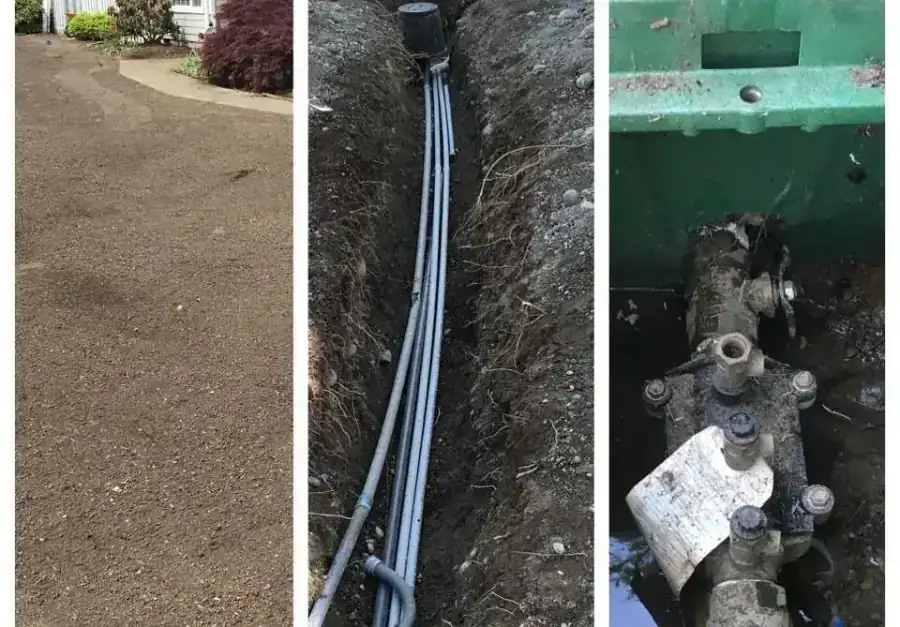
Irrigation trenching and a backflow valve install
Zoning by hydrozone, not by whatever's easiest to trench
A lawn, a planted bed, and a shaded area under mature trees don't drink water at the same rate, and putting all three on one zone means the schedule is always wrong for at least one of them, running too long for the shade bed while still leaving the lawn thirsty, or the reverse. Zoning by hydrozone groups areas with similar water needs onto their own circuit and controller programme, so a lawn zone can run on its own cycle independent of a drip zone feeding a planted bed, and neither one is compromising for the other.
Head spacing follows the same logic inside a single zone: spray heads are laid out for head-to-head coverage, meaning each head's spray pattern reaches the next head over, so there's no dry gap between them and no doubled-up wet spot where two patterns overlap too far. Beds get drip line instead of spray wherever possible, delivering water at the root zone directly rather than wetting foliage, which cuts evaporation loss and keeps water off leaves where it can encourage disease.
Chapter 03
What a backflow preventer is actually protecting, and why it's not optional
A backflow is the unwanted reversal of water into a clean water supply, and every irrigation system needs a backflow preventer to stop irrigation water contaminating drinking water with fertilizers, bacteria, or pesticides that have been sitting in the irrigation lines. It sounds like a small fitting for what it does, but it's the one component standing between a lawn's water supply and a household's, and it isn't something a system should ever run without.
Depending on the city a property sits in, a backflow preventer may require a permit and an annual inspection, and Archterra helps with that where the city requires it. That's not paperwork tacked onto the job for its own sake, it's the mechanism that keeps the protection actually verified year over year rather than installed once and forgotten, which is exactly the kind of detail that gets skipped on a system nobody's checking on.
Start-up in spring, blow-out before the first freeze
Archterra runs annual start-up and winterization services on the systems it maintains. Start-up in spring means walking every zone, checking each head for proper coverage and pattern, checking the backflow preventer, and resetting the controller for the season ahead rather than assuming everything picked up exactly where it left off the previous fall. A system that sat dormant over winter can develop a cracked head, a slipped fitting, or a stuck valve that nobody notices until the first hot week of the season, when the zone that isn't running is the one costing a bed or a lawn its health.
Winterization, or blow-out, matters because water left standing in a line when the ground freezes has nowhere to go, and a lateral or a fitting that splits under that pressure isn't a visible failure until the system is turned back on in spring and the leak shows up as a soaked patch where there shouldn't be one. Compressed air pushed through every zone clears the lines before a hard freeze arrives, and skipping that one seasonal step is the single most common way an otherwise well-built system ends up needing repair work it never should have.
Archterra Landscape Services — locally owned and family-operated since 2005, no subcontractors. Call (253) 815-8365.
Controllers do the daily adjusting a homeowner shouldn't have to
A schedule set once in June and never touched again is one of the most common reasons a system either overwaters through a cool, wet stretch or underwaters through a heat spike. A controller programmed with seasonal adjustment in mind, and checked at each start-up and winterization visit, keeps every zone running close to what the plants actually need as the weather shifts through the season, instead of running the same fixed schedule from April through October regardless of what's actually falling from the sky that week.
For commercial, multifamily, and large residential estates, irrigation monitoring and repair is handled as part of a full-service landscape management plan, with backflow testing coordinated wherever the city the property sits in requires it.