Hardscape
Paver Driveways, Patios & Walkways
Driveways, patios, covered patios, pool pavers and walkways, set on a base built to hold its line through a wet Puyallup winter instead of heaving by spring.
Chapter 01
The base is the job, the pavers are just what you see
A paver surface is only as good as what's underneath it, and that's true whether it's a driveway apron carrying a truck or a garden walkway carrying foot traffic. The visible pavers are the last two inches of a system that starts with excavation down past the topsoil and organic material, because anything that can decompose or compress under load is exactly what a paver field can't be sitting on. What replaces it is a compacted crushed base, built up in lifts and run over with a plate compactor between each one rather than dumped in all at once and tamped down on top, then a thin bedding layer of concrete sand that gives the pavers a uniform surface to seat into.
Skip a lift, rush the compaction, or skimp on base depth for a driveway compared to a garden path, and the base keeps compressing after the job is done, just slower than you'd notice at handover. Six months or a winter later, that shows up as a dip where a tire rolls through most often, or a low spot that starts holding water after a storm. There's no fixing that from the surface. It has to be pulled up and rebuilt from the base, which is the whole reason the base gets the time and the equipment the finished photo never shows.
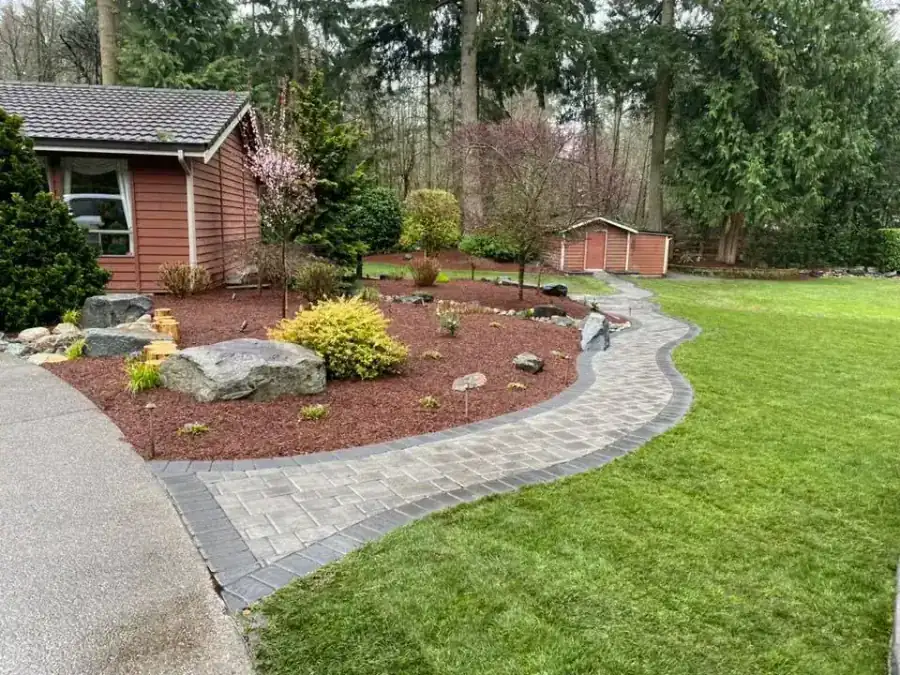
Curved paver walkway through a planted bed
Why a Puyallup winter is harder on hardscape than the calendar suggests
The Pacific Northwest doesn't get the deep hard freezes some regions do, but it gets long stretches of saturated ground, and a base that can't drain holds water against the underside of the pavers for weeks at a time instead of days. Wet base material loses strength, and a freeze-thaw cycle on top of ground that's already saturated is what actually pushes and heaves a poorly built surface, not one hard freeze on its own. That's the argument for open-graded crushed base over anything with too many fines mixed in: fines fill the voids between the aggregate, and the voids are what let water move through instead of pooling.
The other half of managing water is grade, and it has to be planned before the first paver goes down, not adjusted after. Every hardscape surface needs a fall away from the house, garage or any structure it's next to, typically a couple of percent, so rain moves off the surface toward a lawn, a bed, or a drain rather than sitting against a foundation or re-saturating the base it just drained.
Chapter 03
Edge restraint, joints, and why a paver field can start to spread
Pavers aren't glued to each other or to the base; they're locked together by compaction and by whatever holds the outside edge of the field from moving. That's the job of edge restraint, a rigid or flexible border spiked into the base along every open edge of the installation. Without it, the outermost row of pavers has nothing pushing back against foot traffic, tires, or seasonal ground movement, and over time the whole field creeps outward at the edges, opening gaps in the joints that show up first at the perimeter and work inward.
The joints themselves get filled with polymeric or regular joint sand, swept in and vibrated down into the gaps between pavers, and that sand is doing real structural work: it locks adjacent pavers together so load transfers across the whole surface instead of concentrating on whichever paver takes the direct hit. Traffic and rain wash a little joint sand out over the years, which is why re-sanding is routine maintenance, not a sign anything went wrong.
Efflorescence, settlement at transitions, and what maintenance actually covers
New pavers, especially concrete pavers, often go through a stage where a white, powdery haze shows up on the surface, usually after the first few wet-dry cycles. That's efflorescence, mineral salts carried to the surface as moisture moves through the paver and evaporates, and it's a cosmetic phase in the material's life, not a defect in the installation. It weathers off with normal rain and foot traffic over a season or two, and pressure washing speeds that along if it's bothering you sooner.
The other spot that shows wear first is any transition, where a paver walkway meets a poured driveway apron, a garage slab, or a set of concrete steps. Two different materials sitting next to each other settle at slightly different rates, so that seam is worth a look every year or two. Paver maintenance is what keeps a field looking and performing like new: lifting sections that have settled, adding or removing base material to relevel them, resetting the pavers, and re-sanding the joints, all without disturbing the rest of the field. That's the real advantage pavers have over a poured slab. A cracked slab has to be broken out and replaced; a settled paver field gets relevelled and put back down. For any hardscape work that needs a permit, that gets established at the design consultation, and Archterra handles submitting the applications.
Archterra Landscape Services — locally owned and family-operated since 2005, no subcontractors. Call (253) 815-8365.
Stairs and seat walls, built with the field, not added after
Where a paver field changes elevation, the stairs and any seat walls around it get planned into the base and drainage work from the start rather than tacked onto a finished patio. A paver staircase carries the same base-depth and compaction rules as the flat field it connects to, and a seat wall doing double duty as a patio edge needs its own footing so it doesn't settle at a different rate than the pavers it sits beside. Planning steps and seating with the hardscape, rather than as an afterthought, is what keeps the whole surface reading as one built system instead of a patio with extras bolted on.
Pool surrounds get the same base and drainage discipline, with an added focus on fall direction: every pool paver field needs to shed water away from the coping and the pool edge itself, not just away from the house.